When we think of school, the default image is often a teacher standing at a whiteboard, delivering facts to rows of silent children. But over a century ago, an Italian physician named Maria Montessori stumbled upon a discovery that challenged this industrial model of education. She found that children are not empty vessels waiting to be filled, but self-directed learners who, when given the right environment, thrive on autonomy rather than instruction.
The story of Montessori education is not just about a teaching method; it is about a fundamental shift in how we view the capabilities of the developing human mind. It suggests that the best way to help a child succeed is, paradoxically, to step back and stop helping them so much.
Contents
From Special Needs to Global Standard
The roots of this educational philosophy are humble and surprisingly clinical. Maria Montessori opened her first school, the Casa dei Bambini or “Home for Children,” in 1907. It wasn’t located in a prestigious academic center but in an apartment building for low-income workers in Rome.
Interestingly, the unique materials that define a Montessori classroom today—the tactile puzzles, the beads, the sensory blocks—were not originally designed for average students. Montessori developed them during her earlier career working with children who experienced mental disabilities. She observed that these children understood complex concepts much better when they could engage all their senses, not just their ears. When she applied these same principles to the children in her Rome school, the results were transformative.
The Concept of the Prepared Environment
In that first Casa, the classroom looked nothing like a traditional school. It was furnished with child-sized tables, chairs, and accessible cabinets filled with her specialized materials. The curriculum wasn’t focused on memorizing dates or multiplication tables initially; it focused on “practical life.”
Children spent their time learning personal care, such as dressing and undressing themselves, and environmental care, like sweeping, dusting, and gardening. This wasn’t just about chores; it was about ownership. By allowing children to manipulate their environment and care for their space, Montessori gave them a sense of agency that traditional schooling often strips away.
The Teacher as a Ghost
One of the most radical shifts Montessori introduced was the changing role of the teacher. In her model, the teacher does not stand at the front of the room commanding attention. Instead, they act as a “facilitator.”
Maria Montessori herself did not teach in the traditional sense; she oversaw the work of her teachers, instructing them to observe rather than interfere. The goal was to guide young human beings to move and act freely within the limits of the prepared environment. This approach is best summarized by her famous directive: “Never help a child with a task at which he feels he can succeed.” This restraint allows the child to build confidence through struggle and eventual mastery, rather than becoming dependent on adult intervention.
The Discovery of Spontaneous Discipline
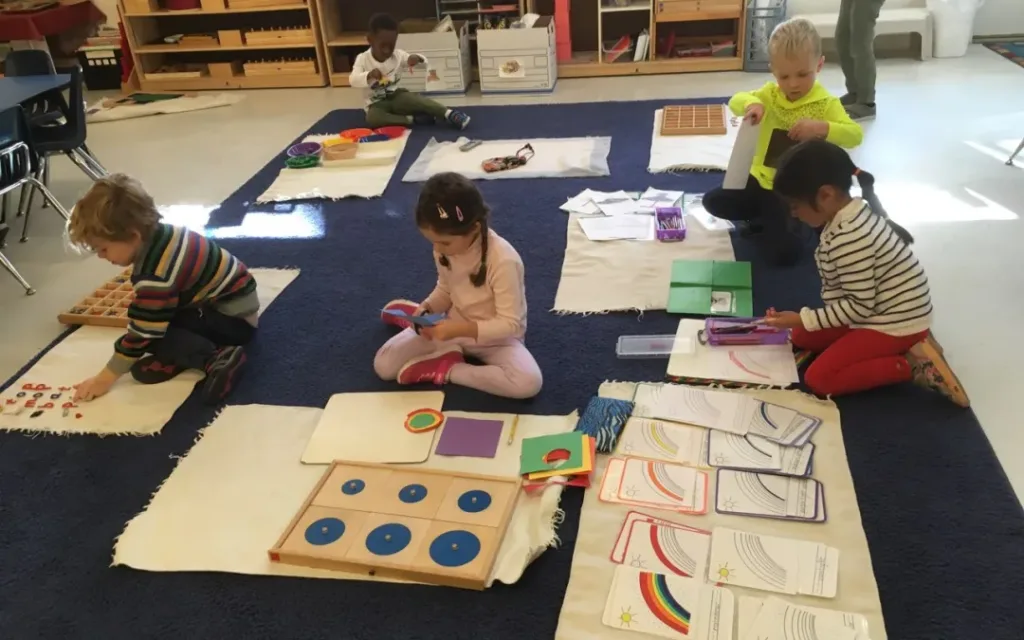
The most surprising result of Montessori’s experiment was the behavior of the children. Without rewards, punishments, or strict commands, a phenomenon she called “spontaneous self-discipline” emerged.
Observers noted that the children engaged in episodes of deep concentration, often repeating the same activity multiple times until they were satisfied. Given a free choice between normal toys, sweets, and the learning materials, the children consistently chose the practical activities. They wanted to work. They wanted to learn. This led to the conclusion that when children work independently, they reach new levels of autonomy and become self-motivated learners, removing the need for external coercion.
A Legacy of Innovators
The success of the Casa dei Bambini was undeniable. Montessori and her ideas soon traveled the world, attracting the attention of progressive thinkers and inventors. Early advocates included titans of innovation like Alexander Graham Bell and Thomas Edison.
The method’s emphasis on self-directed exploration has a track record of producing creative adults. Notable alumni include Jimmy Wales, the founder of Wikipedia; author Gabriel Garcia Marquez; and perhaps most famously, the two founders of Google, Larry Page and Sergey Brin. It is no coincidence that the creators of the world’s most powerful search engine came from an educational background that encourages following one’s curiosity wherever it leads.
Defining the Modern Montessori Method
Today, “Montessori” is a term used to describe a method rather than a specific trademarked institution, which has led to great variation in quality and interpretation. However, authentic programs generally share specific characteristics that distinguish them from standard schools.
Students are typically free to move around the classroom and choose what they want to learn during uninterrupted blocks of study time, often lasting three hours. Classes are mixed-age, usually grouped in three-year spans (such as ages 3 to 6 or 6 to 12). This allows younger children to learn from older peers, while older students reinforce their knowledge by teaching. There are no grades, no homework, and no standardized tests. The focus remains, as it did in 1907, on growing children into independent, responsible adults who share a genuine love for learning.